
Stay on your toes. Eyes on the ball. Keep the glove down. Two hands. I’d figure any child who has stepped on a ball-field and played organized baseball is familiar with one or more of those previously mentioned sentiments. Tips hollered by coaches from the dugout towards players, in many circumstances after a botched play. In a perfect world the kid guilty of adhering to these credences removes his tear riddled face from his glove, thanks and flips a thumbs up to his coach; now armed with his newfound enlightenment begins his journey to Cooperstown.
Of course it takes a lot more than baseball mechanics and I.Q. to make it to ‘The Show.’ Though there are a bunch of basic techniques accepted throughout youth ball that, when refined, sets a solid foundation for developing a skilled ballplayer. Need a refresher? Here’s a couple: Level swing, don’t aim, don’t overthrow, don’t slide through first base. If you have made it as far as high school level baseball, you have undoubtedly encountered these anecdotes at some point or another. These teachings are widely regarded as gospel, “tried and true” methods put in place for success. Would it come as any shock if I told you that at least one of these practices is now (and has been for a while) a misguided and outdated approach?
If you are like me, you are probably less and less stunned by most of the new age schemes found in the game today. Gone are the days of the bunt, the stolen base and the hit-and-run. The men behind the curtain in each of the thirty major ball-clubs has deemed this type of play as obsolete and insignificant. To them, the risk always outweighs the reward. A franchise’s analytics team places so much emphasis on the longball. It’s no wonder that when a team finds itself in the now evermore uncommon situation of having runners on base they have no game plan other than let’s hope someone launches a ball over the outfield fence. The rule changes being implemented in this 2023 season favor teams willing to take more liberties with runners on base. I would be remiss to think that those old ways of run manufacturing would make a resurgence overnight.
What better night to do it than a rainy late-season game in the Bronx between two arch-rivals. Many believed that aside from the fact that Aaron Judge entered that night standing on the precipice of history, there were no other major headlines to take away from this exhibition. We couldn’t be further from the truth. Every fan with the good fortune of being a part of this sold out crowd was also equally inauspicious in terms of missing the coinciding broadcast. A broadcast that could be witnessed nationally because of the record breaking implications.
Yankees, Red Sox, a stadium waiting to explode all night with the hopes of Judge tying Roger Maris’ single season Yankee home run record of 61 set back in, wouldn’t you know it, 1961. 61 baseball seasons set in between each other all culminating towards tonight’s matchup.
Baseball is a game of numbers, none would seem more important tonight than 61. However, I’d argue that the most important number stemming from September 25th 2022 was the number ‘2’. Two runs… Two runs scored total in just over two hours of a rain-shortened six inning snoozer between two pitchers that are heralded across the league as fast workers. New York’s Nestor Cortes wasted no time in delivering the ball to home. If you told me he had incentives written throughout his contract promoting the shortest duration of time spent on the mound as a starting pitcher with minimum 130 innings pitched I would believe you. He would go on to get his first-and-only complete game of the season. Yes, it was shortened by rain, but in the history books it counts as a complete game shutout. His counterpart, Brayan Bello, took the mound for Boston and mirrored Nestor’s ‘blink and you’ll miss it’ pace between pitches. Still somehow tonight’s game seemed to drag on. Sure, if you asked for a ‘pitcher’s showdown’ that is exactly what you received. I would be skeptical if you claimed that before the game you expected this from both ball-clubs starters. I believe the mass majority of fans were hoping for fireworks to be put on display supplied from the power bats within each clubs respective lineups. Only for those hopes to be quickly extinguished when storm clouds rolled in shortly after the start of the sixth inning of play.
Head Groundskeeper Danny Cunningham didn’t waste any time deciding to drag the tarp over the field with the help of his grounds crew. By that time, the game was official and would go down in the books as a Yankees win, why chance it? I suppose onlookers that had come to witness history would argue against that decision. The major counterclaim for continuance being Aaron Judge was due up at bat the following bottom half of the seventh inning. I myself was relieved to see that tarp dragged over that damp, dreary field. The offense between both teams tonight had matched the dismal weather pattern. It would have been cool to see Judge mash a record tying homer off his division rivals, but far less cool if he tweaked an ankle on a rain soaked field.
If you, like myself, decided to watch the game from home, you came out on top. Over on ESPN2, baseball analysts Michael Kay and Alex Rodriguez commented on the live broadcast. I use the word “commented” because unlike many other baseball broadcast analysts, they are not there to announce or deliver a play-by-play breakdown of the game. Rather contribute insight and stories surrounding the game itself. Imagine having an overzealous baseball fan friend of yours over to watch the game with you. Well multiply that by ten and that’s what you have with the KayRod cast. If you are one who doesn’t like listening to talking throughout a broadcast this presentation isn’t for you. However if you are like me and appreciate the inner workings of a baseball mind and aren’t impartial to “at some times” excruciatingly long winded baseball analysis from former and current greats, then this program is designed especially for you.
Today, the default broadcast/presentation is marketed for everyone in mind. I can’t fault baseball for this, you don’t want to create any barriers to entry in terms of attracting newcomers to the sport. Though when the sport itself fails to provide a degree of excitement on a game to game basis, whether contrived from lack of offense or repeated fruitless scoring tactics, maybe it wouldn’t hurt to change. And by change I mean the channel.
The most compelling highlight of the nationally broadcasted game took place off the field. When two former major league legends took a moment to dissect former Yankee and current Red Sox outfielder Rob Refsnyder committing an error in the bottom of the 6th inning. Marwin Gonzalez lifted a pop fly into right field, and while running down the first base line, all but conceded what many assumed would result in a routine fly ball out. Marwin expressed this belief by removing his helmet before rounding first base. The error by Refsnyder allowed Aaron Hicks to score from first base, credit to at least one player who had elected to run hard, while Marwin would remain stranded on first.
That outcome aside is a whole story in itself, though my focus is more on the remarks made by legends Alex Rodriguez and guest Barry Bonds that immediately followed the fielding mistake. A-Rod noted that Refsnyder was more accustomed to playing infield and as an infielder you are taught to catch fly balls with two hands. The same technique he used to his detriment on the play before.
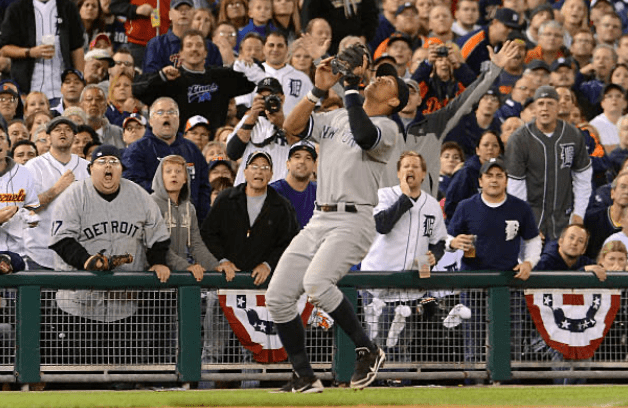
Alex followed that statement by claiming an outfielder should never attempt to catch a fly ball with two hands, which Barry Bonds, an eight-time gold glove winning outfielder concurred. Anyone who has a passion for furthering one’s baseball knowledge should check it out at the 2:15:15 mark.
I sat there in awe, my ears and mind astonished by the information being given to me by two of the greatest players to ever step foot on the diamond. For years I was taught to use two hands when fielding a flyball regardless of position. A practice drilled into my brain, preached by every coach spanning from t-ball to college level. If I had a nickel for every time I heard “two hands” yelled in the direction of an unlucky outfielder I believe I would have enough money to purchase the Miami Marlins.
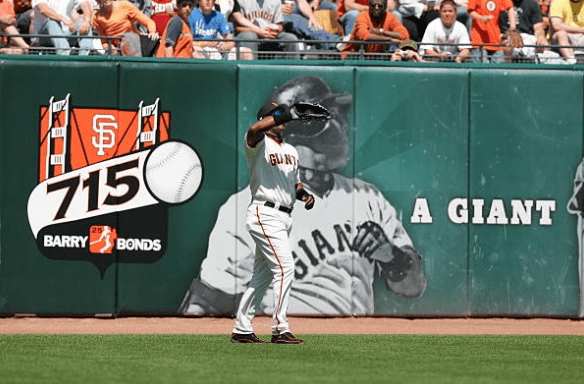
Jokes aside, I remained pondering reasons why such a technique was ever conceived in the first place. The best reason I could come up with for why using two-hands as an outfielder would for any reason ever be accepted was probably formed out of necessity rather than practicality. Ever wonder what baseball equipment looked like during the dead-ball era? If you have the privilege of seeing a glove from that time period it becomes increasingly easier to see how a practice like “two hands” would be adopted.
Baseball’s gear and traditions have evolved heavily since then. For better or worse, rationale for certain methods being used in today’s game are varied, though one thing is for certain. If you ever encounter a coach who bombards you with the mantra “two hands” when fielding a fly ball in the outfield, simply respond with the following two words: ‘No thanks.’
When doing so, I implore you to cite the teachings of A-Rod and Barry Bonds covered throughout tonight’s broadcast. Getting the chance to pick the brain of two baseball legends dissecting the reasons for that error are unmatched to me. Lessons like these are better suited coming from teachers like Barry and Alex than myself alone. The advice given was twice as interesting than anything that went on during the game and even better, takes only two minutes to consume.
 BS Reports
Leave a comment